Cox's Bazar (Bengali:
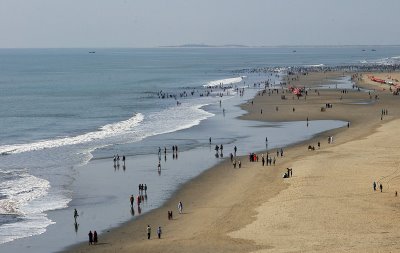
কক্সবাজার) is a town, a fishing port and district headquarters in Bangladesh. It is known for its wide sandy beach which is the world's longest natural sandy sea beach. It is an unbroken 125 km sandy sea beach with a gentle slope. It is located 150 km south of the industrial port Chittagong. Today, Cox's Bazar is one of the most-visited tourist destinations in Bangladesh, however it has yet to become a major international tourist destination, with no international hotel chains operating here, due to lack of publicity and transportation.

The greater Chittagong area including Cox's Bazar was under the rule of Arakan Kings from the early 9th century until its conquest by the Mughals in 1666 AD. When the Mughal Prince Shah Shuja was passing through the hilly terrain of the present day Cox’s Bazar on his way to Arakan, he was attracted to the scenic and captivating beauty of the place. He commanded his forces to camp there. His retinue of one thousand palanquins stopped there for some time. A place named
Dulahazara,meaning "one thousand palanquins," still exists in the area. After the Mughals, the place came under the control of the Tipras and the Arakanese, followed by the Portuguese and then the British.

The name Cox's Bazar/Bazaar originated from the name of a British East India Company officer, Captain Hiram Cox who was appointed as the Superintendent of Palonki (today's Cox's Bazar) outpost after Warren Hastings became the Governor of Bengal following the British East India Company Act in 1773. Captain Cox was especially mobilised to deal with a century long conflict between Arakan refugees & local Rakhains at Palonki. The Captain had rehabilitated many refugees in the area, but had died (in 1799) before he could finish his work. To commemorate that, a market was established and named after him, called Cox's Bazar (market of Cox). Cox's Bazar than was first established in 1854 and became a municipality in 1869.

After the Sepoy Mutiny (Indian Rebellion of 1857) in 1857, the British East India Company was highly criticised and questioned on humanitarian grounds, specially for its Opium trade monopoly over the Indian Sub-Continent. However, after its dissolution on 1 January 1874, all of the company's assets including its Armed Forces were acquired by the British Crown. After this historic take over, Cox's Bazar was declared a district of the Bengal Province under the British Crown.
In 1971, Cox's Bazar wharf was used as a naval port by the Pakistan Navy's gunboats. This and the nearby airstrip of the Pakistan Air Force were the scene of intense shelling by the Indian Navy during Bangladesh Liberation War. During the war, Pakistani soldiers killed many people in the town including eminent lawyer Jnanendralal Chowdhury. The killing of two freedom fighters named Farhad and Subhash at Badar Mokam area is also recorded in history.
After the independence of Bangladesh Cox's Bazar started to get the administrative attention. In 1972 the town committee of Cox's Bazar was again turned into a municipality. In 1975, The Government of Bangladesh established a pilot plant at Kalatali. Later, in 1984 Cox's Bazar subdivision was promoted to a district and five years later (in 1989) the Cox's Bazar municipality was elevated to B-grade.
In 1994 (jobs) the Marine Fisheries and Technology Station (MFTS) was established at Cox's Bazar. MFTS is a research station of Bangladesh Fisheries Research Institute (BFRI) headquartered in Mymensingh. The station covers a land area of four hectares and contains five laboratories. In April 2007 Bangladesh got connected to the submarine cable network as a member of the SEA-ME-WE-4 Consortium, as Cox's Bazar was selected as the landing station of the submarine cable.
Panorama of Cox's Bazar in the early morning: clouds on a blue sky, still water and forest in the distance.
Cox's Bazar town with an area of 6.85 km², is located at
21°35′0″N 92°01′0″Eand bounded by Bakkhali River on the north and East, Bay of Bengal in the West, and Jhilwanj Union in the south.
The climate of Bangladesh is mostly determined by its location in the tropical monsoon region: high temperature, heavy rainfall, generally excessive humidity, and distinct seasonal variations.
The climate of Cox's bazar is mostly similar to the rest of the country. It is further characterised by the location in the coastal area. The annual average temperature in Cox's Bazar remains at about a maximum of 34.8 °C and a minimum of 16.1 °C. The average amount of rainfall remains at 4,285 mm.
Photo Gallery:


 founded by him. This place was earlier called 'Srinagari' or Purandhisthan. The Brahmins who inhabited these areas admired and adorned Buddhism too. From the regions of Kashmir Buddhism spread of Ladakh, Tibet, Central Asia and China. Various traditions co-existed till the advent of the Muslims.
 founded by him. This place was earlier called 'Srinagari' or Purandhisthan. The Brahmins who inhabited these areas admired and adorned Buddhism too. From the regions of Kashmir Buddhism spread of Ladakh, Tibet, Central Asia and China. Various traditions co-existed till the advent of the Muslims.




.jpg)


.jpg)


%5Bwww.wall4pc.com%5D.jpg)


.png)


.jpg)
